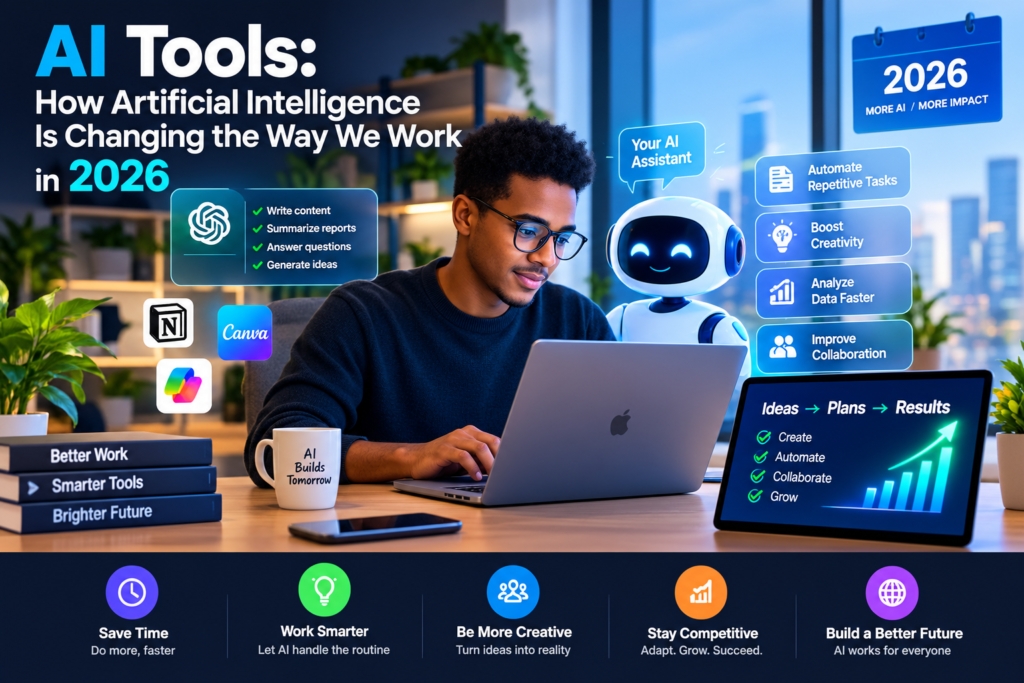
Artificial intelligence (AI) has quickly become an important part of modern software and digital work. From writing and research to design, coding, communication, and task management, AI tools can help people complete many everyday tasks more efficiently. in this particular content am gonna share with you 10 Best AI Tools to Improve Productivity and Work in 2026
In 2026, AI is no longer limited to experimental technology. Students, freelancers, content creators, developers, entrepreneurs, and businesses are using AI-powered software to assist with real-world work. However, different AI tools are designed for different purposes, so choosing the right tool depends on the task you want to accomplish.
What Are AI Tools?
AI tools are software applications that use artificial intelligence to perform or assist with specific tasks. Depending on the tool, AI can generate text, analyze information, summarize documents, create images, assist with coding, improve writing, organize information, or automate repetitive work.
Some AI tools are designed as general-purpose assistants, while others focus on specific areas such as writing, design, research, productivity, or software development.
How AI Tools Can Improve Productivity
One of the main reasons people use AI tools is to reduce the amount of time spent on repetitive or time-consuming tasks.
For example, an AI assistant can help create a first draft of an email, summarize a long document, organize information, or explain a difficult topic. Research on generative AI suggests that productivity benefits are real in some tasks, although the results vary depending on the type of work and how the technology is used.
AI can also work alongside existing software. Modern productivity platforms increasingly integrate AI into tools people already use rather than requiring users to move everything to a separate application.
Popular Types of AI Tools (10 Best AI Tools to Improve Productivity and Work in 2026)
There are many categories of AI software available today. Understanding these categories can make it easier to find a tool that matches your needs.
1. AI Writing Tools
AI writing tools can help users draft articles, emails, social media posts, reports, and other types of written content.
They can also assist with grammar, spelling, tone, and clarity. However, users should review AI-generated content before publishing it, especially when accuracy and originality are important.
2. AI Research Tools
Research-focused AI tools can help users find information, summarize documents, and understand large amounts of content more quickly.
Some modern research tools can also provide citations or work with documents supplied by the user. These features can be useful for students, researchers, writers, and professionals.
3. AI Coding Tools
AI coding tools are designed to assist developers with programming tasks. They can help explain code, generate code snippets, identify potential errors, and assist with software development.
AI coding systems are also increasingly being used for tasks beyond traditional programming, including research, data analysis, documentation, and workflow automation.
4. AI Image and Design Tools
AI-powered design tools can generate images, modify existing graphics, remove backgrounds, create visual concepts, and assist with creative projects.
These tools can be useful for bloggers, marketers, social media creators, designers, and small businesses that need visual content.
5. AI Productivity Tools
Productivity-focused AI tools can help users organize information, summarize meetings, manage tasks, and automate repetitive workflows.
For example, tools such as Notion AI and other integrated productivity platforms combine AI capabilities with existing note-taking, project management, and knowledge-management systems.
Examples like
Some widely discussed AI tools in 2026 include ChatGPT, Claude, Perplexity, NotebookLM, Grammarly, and Notion AI. Each serves somewhat different purposes, from general assistance and research to writing and organization.
ChatGPT
ChatGPT can assist with writing, brainstorming, research, coding, explanations, and many other tasks. Its capabilities have also expanded toward working with files, applications, and longer projects.
Claude
Claude is an AI assistant that can be used for writing, analysis, coding, and working with longer pieces of information.
Perplexity
Perplexity focuses strongly on AI-assisted search and research, making it useful for users who want to explore topics and find information online.
NotebookLM
NotebookLM is designed around working with information and documents supplied by the user. It can help users understand and summarize their own source material.
Grammarly
Grammarly uses AI to help users improve writing, including grammar, clarity, tone, and communication.
Notion AI
Notion AI integrates artificial intelligence into the Notion workspace, allowing users to work with notes, documents, projects, and other information.
Benefits of Using AI Tools
AI tools can provide several practical benefits when used appropriately.
Save time: AI can assist with repetitive tasks and help users create initial drafts more quickly.
Improve organization: AI can summarize information and help users manage large amounts of content.
Support creativity: AI can generate ideas, outlines, visual concepts, and different approaches to a problem.
Assist learning: Students can use AI to explain difficult concepts, summarize material, and create study resources.
Support businesses: Businesses can use AI for customer communication, content creation, research, data analysis, and workflow automation.
However, productivity improvements are not automatic. Research from the International Labour Organization indicates that productivity gains from generative AI vary across tasks and that measurable benefits do not always translate directly into higher output or earnings.
Things to Consider Before Using an AI Tool
Choosing an AI tool should involve more than looking at how popular it is.
Check the Features
Make sure the tool actually provides the features you need. A tool designed for writing may not be suitable for advanced research or coding.
Consider Privacy
Avoid entering sensitive personal, financial, or confidential business information into an AI service unless you understand how that information is handled.
Verify Important Information
AI systems can produce incorrect or incomplete information. Important facts should be checked against reliable sources before being used in professional, academic, financial, or other important situations.
Compare Pricing
Many AI tools offer free plans with limitations and paid subscriptions with additional features. Check the current pricing and available features before subscribing.
The Future of AI Tools
AI software is continuing to move from simple question-and-answer systems toward tools that can assist with complete workflows.
In 2026, companies are increasingly exploring AI systems that can research information, work across connected applications, create documents, analyze data, and automate multi-step tasks.
This does not mean that AI will replace every type of work. Instead, the technology is increasingly becoming another digital tool that people can use to complete tasks and solve problems.
For individuals and businesses, the most useful approach may be to identify repetitive or time-consuming tasks first and then find an AI tool that can assist with those specific tasks.
Final Thoughts
AI tools are becoming an important part of modern software and productivity. Whether you are a student, freelancer, developer, content creator, or business owner, there are AI applications designed to help with different types of work.
The key is not simply to use as many AI tools as possible. Instead, choose tools that solve real problems, review their output carefully, and understand their limitations.
As AI technology continues to develop throughout 2026 and beyond, learning how to use these tools effectively can become an increasingly useful digital skill.
Frequently Asked Questions
What are AI tools?
AI tools are software applications that use artificial intelligence to assist with tasks such as writing, research, coding, design, analysis, and productivity.
What can AI tools be used for?
AI tools can be used for writing, research, coding, image creation, document analysis, task management, brainstorming, and workflow automation.
Are AI tools free?
Some AI tools offer free plans, while others require a subscription for advanced features. Pricing and features can change over time.
Can AI tools replace human workers?
AI can automate or assist with certain tasks, but its impact varies significantly by occupation and task. Human review, judgment, creativity, and responsibility remain important in many types of work.
How should I choose an AI tool?
Start by identifying the task you want to improve, then compare tools based on features, accuracy, privacy, ease of use, integrations, and pricing.
Are AI-generated results always accurate?
No. AI-generated information can contain errors, so important information should be independently checked before relying on it.
also there is another apps you can can use so that help you save alot of your time easily https://abdilahiguide.com/10-essential_apps_that-can-improve-your-productivity-in-2026/